Did Minority Report Come True? Six Predictions Checked
Spielberg's 2054 got the gesture interface and the driverless car right and Precrime wrong. Here is each claim from our ledger, with its status, and three stories for anyone who wants more.
Partly. Minority Report did not come true where it mattered most: no police force arrests people for crimes they haven't committed, and the best-known predictive policing tool was dropped after its makers failed to show it worked. But the film's technology landed: driverless taxis carry paying passengers, gesture computing has shipped, and face recognition in public places is spreading.
Spielberg's film, released in 2002 and set in 2054, scores 8.3 in our archive and its Nearness reading is ARRIVING. It's also a good test case for how fiction is checked. The prediction the story was built on, Precrime, is the one that diverged. The details around it, which the film's 1999 think tank worked hard on, did better.
Below is each of the six claims in the film's ledger. For the sources and the full reasoning, read the review and the ledger at the end of it.
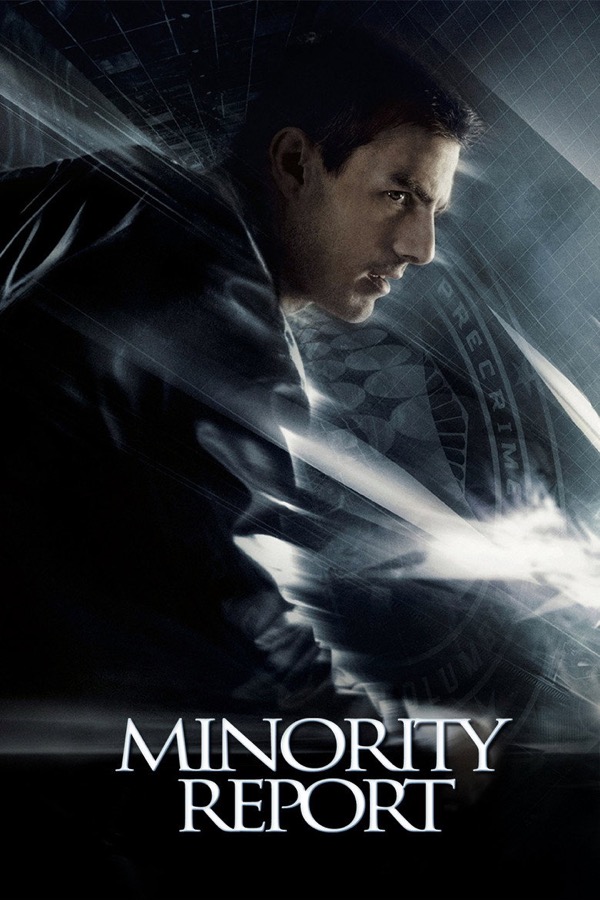
John Anderton, chief of Washington's Precrime unit, is forecast to murder a stranger and spends two hours running from his own future. It's a great, grimy entertainment, and Samantha Morton's Agatha owns it. The last half-hour is a mess and the product placement is loud. It missed the phone: everyone in its 2054 looks up at walls, while we look down at a slab of glass. Our companion essay is Minority Report Was Wrong About the Crime.
Claim by claim
Arrests for crimes not yet committed: DIVERGED. This is the weightiest claim, and it didn't happen. The nearest real versions forecast places or score individuals for police attention. An independent test of Geolitica's (formerly PredPol's) predictions in Plainfield, New Jersey, found fewer than half of one per cent matched a reported crime, and the LAPD stopped using PredPol in 2020. Since February 2025 the EU AI Act has banned predicting an individual's offending based solely on profiling. The impulse survives: the UK Ministry of Justice has been researching person-level risk prediction.
Public screens that address you by name: ARRIVING. Camera-equipped billboards estimate a viewer's age and gender and switch the advert, but their operators say they detect faces rather than recognise people. São Paulo's metro operator was ordered to stop, and Canada's privacy commissioner opened an investigation in 2025. Personalisation by identity mostly arrived on phones.
Gesture-controlled computers: ARRIVED. Apple's Vision Pro went on sale in February 2024 with an interface driven by eyes, finger taps and wrist flicks, and Meta's 2025 display glasses read pinches through a wristband. It sold well below expectations, and gesture walls haven't become office furniture.
Automatic identification in public: ARRIVING. The film imagined retinal scans. The real thing is face recognition from ordinary cameras. London's police ran fixed live cameras in Croydon that scanned more than 470,000 passers-by in a six-month pilot, and Clearview AI built a database of about 30 billion scraped faces. European regulators have fined Clearview, and the EU AI Act restricts real-time police biometric identification in public.
Driverless cars: ARRIVED. Waymo opened fully driverless public rides in the Phoenix area in October 2020 and reported about 400,000 paid rides a week by February 2026. California suspended Cruise's permits in 2023, and General Motors abandoned robotaxis the following year.
Live e-paper newspapers: DIVERGED. Flexible e-paper exists, but it refreshes too slowly, and Plastic Logic cancelled its newspaper reader in 2010 after the iPad arrived. News that updates as you read did arrive, on phones.
If you want the same fear in other forms

The film's fear is a system that sorts you before you act. "Nosedive" is the consumer version: a score that decides who gets a flat or a flight. Its single public number never arrived, but private ratings and tenant scores did. Watch it for the emotional economy of being rated, which it got exactly right.

Dave Eggers's novel is about cameras and a company that wants everything seen. Its record on cameras, DNA searches and a single login is better than its reputation, though the novel itself is weak at 5.4. It's the place to go for the surveillance Spielberg skipped.
It saw the ranking of strangers by sight, and our review notes that in 2024 two Harvard students linked Meta's camera glasses to a face-search engine and pulled names and addresses in seconds. A funnier, messier route to the same worry.
Is predictive policing real?
Yes, in weaker forms. Tools such as PredPol forecast places, not people, and have been criticised for poor accuracy: in Plainfield, fewer than half of one per cent of predictions matched a reported crime. The LAPD stopped using PredPol in 2020. Our ledger marks arrests before any offence as DIVERGED.
Is the Minority Report gesture interface real?
Yes, but modestly. The interface was designed by the MIT researcher John Underkoffler, per our review. Apple's Vision Pro and Meta's 2025 display glasses now use gesture input, but neither has made waving at screens ordinary.
Does the EU ban Minority Report-style policing?
Partly. Since February 2025 the EU AI Act has prohibited AI that predicts whether a person will commit an offence based solely on profiling. The ban is limited to assessments based solely on profiling.
What should I watch after Minority Report?
Start with movies like Minority Report, then the wider list of sci-fi about surveillance.